

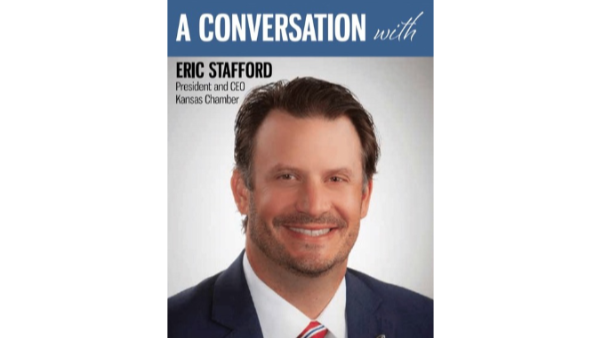
A Conversation With Eric Stafford
Eric Stafford, president and CEO of the Kansas Chamber, is focused on listening to employers, strengthening the state’s business climate and positioning Kansas to compete for people and investment. In a conversation with TK Business Magazine, he discussed the experiences that prepared him to lead the chamber, what he is hearing from businesses across the state and where he sees opportunities for Kansas in the years ahead.
TK: You joined the Kansas Chamber in 2011. What experiences have best prepared you to lead it as president and CEO?
STAFFORD: A big part of it is understanding our mission and what our members expect from us: to continue being the strongest business advocacy organization in the state, representing Kansas businesses at the Statehouse and protecting free, competitive enterprise.
Over 15 years, I have worked under several CEOs and had really good mentors. I have been able to learn from their strengths and weaknesses while understanding my own strengths and weaknesses and how I can continue to grow as a leader.
We have a really strong team, and part of my responsibility is making sure people are in positions where we can amplify their strengths and they can execute to the best of their abilities.
TK: How has your background in government affairs and advocacy shaped the way you lead the chamber?
STAFFORD: It helps you understand the realities of the challenges business owners face. Every company is different. Every industry is different, and even companies within the same industry can be very different.
One of the things I have loved about lobbying at the Statehouse is knowing that when a member, an industry or a group of businesses is experiencing a problem, we have an opportunity to help fix it. Sometimes it takes longer than we would like, but there is nothing more rewarding than getting a bill passed that you know is going to have a positive impact on the business community.
Our policies are intended to help businesses of all sizes. In many cases, smaller businesses feel regulatory and compliance burdens even more because they do not have entire departments devoted to those issues. The owner may be handling human resources, accounting and everything else. That is why listening to our membership is so important. Regular communication matters.
TK: What lessons from working under different leaders influence how you lead?
STAFFORD: I look at leadership on two fronts. There is leading and managing the team internally, and there is leading and managing the vision our board and members have set for us externally. Both are critical.
My experience at the chamber has prepared me well for the external side: communicating what we stand for, talking about the benefits of capitalism and a competitive business climate and thinking about how Kansas competes with other states for investment and people.
Internally, my focus is on maximizing everybody’s potential. We have a really good team. Feedback may not always be positive, but it should come from a place of trust and encouragement rather than simply breaking someone down.
I also think the most effective leaders bring humility. I will do anything that needs to be done, just as I expect everyone else to do. I am not above anything. To me, that is part of leading by example.
TK: What have been your biggest priorities as president and CEO so far?
STAFFORD: Getting out and seeing our members in person has probably been my biggest priority. I effectively stepped into the job March 1, while the legislative session was still underway, so initially I needed to get my bearings and continue being involved at the Statehouse. By April, I started traveling the state and meeting with members.
Businesses are choosing to invest in us, and we cannot take that choice for granted. We need to make sure they continue to see value in what we do.
I also want to reach business leaders who are not members and help them understand the value the chamber provides and why it matters to have a strong voice representing the business community at the Statehouse.
TK: What are you hearing most often from Kansas business leaders?
STAFFORD: Workforce is consistently one of the biggest issues. Businesses are trying to find more qualified and capable employees, and ultimately, part of that is a numbers game. We need more people.
That is one reason we launched our Kansas Forward plan, which looks at what needs to happen to grow the state’s population, economic activity and investment.
The good news is that Kansas has a highly educated workforce. That does not just mean people with advanced degrees. We are above the national average in the number of workers with degrees and certifications. I think our higher education system is mostly in tune with the needs of the business community, although there is still room for improvement in higher education and K-12 education.
We also hear a lot about the state’s legal climate and taxes. Litigation risk creates uncertainty and affects insurance costs. Tax policy affects where businesses choose to invest. Ultimately, businesses want to operate in a predictable, affordable climate that gives them an opportunity to be profitable, reinvest in their companies and take care of their employees.
Some of the solutions to these challenges are not easy. It takes courage to bring those solutions forward and get elected officials thinking critically about the long-term competitiveness of the state.
TK: What issues should the local business community pay attention to?
STAFFORD: One issue I believe the business community needs to be paying close attention to is the growing acceptance of socialist ideas in the political conversation. I think the business community needs to be engaged in helping people understand the benefits of capitalism and free enterprise.
Innovation comes from people creating products and services that others find valuable, whether that is advances in health care, technology or entirely new industries. That ability to create, invest and build something is important not only to businesses, but to individuals and our economy as a whole.
I think we need to be intentional about explaining why free enterprise matters and the role it plays in creating opportunity.
TK: Where do you see the greatest opportunities for Kansas to strengthen its business environment?
STAFFORD: I think our greatest opportunity is to have a serious conversation among the Legislature, the governor’s office and the business community about where we want Kansas to be 20 years from now.
One of the questions we need to ask is how we keep graduates of our technical schools, community colleges, universities and other higher education institutions here.
Kansas is attracting students from outside the state. Our higher education institutions, particularly some of our private institutions, have been very successful at bringing people here. The next question is: How do we keep them?
To me, the opportunity is creating that long-term vision and determining the steps we need to take to get there. Why can’t Kansas become recognized as one of the top states in the country to do business?
Businesses can choose to go anywhere, and people can choose where they want to live. Kansas needs to be in those conversations and competing for talent and investment.
TK: How do you make sure businesses of all sizes and industries are heard when setting priorities?
STAFFORD: Our legislative agenda really starts with our members. We have task groups that meet in late summer and early fall. We bring together experts from member companies in areas such as taxes, human resources, workforce and education, health care, energy and other policy issues.
Then we combine that work with the direct feedback we receive from members throughout the year and input from our board. That is what ultimately sets our priorities.
Unemployment insurance reform is a good example. Businesses helped us identify problems with the system, particularly the unpredictability employers were experiencing. We took that feedback to the Legislature and worked together on reforms that created a much more predictable system.
That process also included investing in modernization at the Department of Labor. We want taxes to be low, but there is a role for government, and we want government to work efficiently. Sometimes that requires investing in technology and infrastructure so government can operate at the level businesses need it to.
That entire effort came out of direct member feedback, and that is really how we formulate policy.
TK: What do you want your leadership to be known for, and what does success look like in three to five years?
STAFFORD: I do not know that I necessarily want it to be about what I am known for. I want Kansas to be known as a place for growth, families and investment. I want it to be a place where employees can make a good living, live out the American dream and start a business without too much government intervention and regulation.
My ideal career goal over the next 10 to 15 years would be to help take Kansas into the top five states for doing business. To me, that is why we exist. It is more about what the state looks like in terms of national competitiveness than it is about me.
Over the next three to five years, success would mean continued improvement in our business climate rankings and more businesses understanding the value of the Kansas Chamber advocating on their behalf.
We are just shy of 500 members today. I would love to see us reach 700 or 750 businesses that believe in our mission and support our efforts to make Kansas more competitive.
TK: What are you most excited about for the chamber’s next chapter?
STAFFORD: On a day-to-day basis, I am probably most excited about the team we have and being able to work with the professionals on our staff. Several of us have worked together for 10 or 12 years, along with some newer faces, and I am excited about what that team can accomplish.
Beyond that, I really believe Kansas is at a crossroads. There is an opportunity to work with elected officials and think seriously about the vision for the state and where we want to go.
We have some strong metrics and real strengths, but we also have challenges. Rural communities, for example, are trying to figure out how to continue providing services when there are fewer people there to pay for them. I think improving the state’s overall competitiveness helps rural Kansas, too. Automation and technological advances can help those communities.
I love our state, and I see tremendous opportunity for the central part of the country. The coasts are heavily developed, and Kansas has room for investment and growth. I hope we continue improving the business climate so Kansas becomes increasingly attractive for future investment.